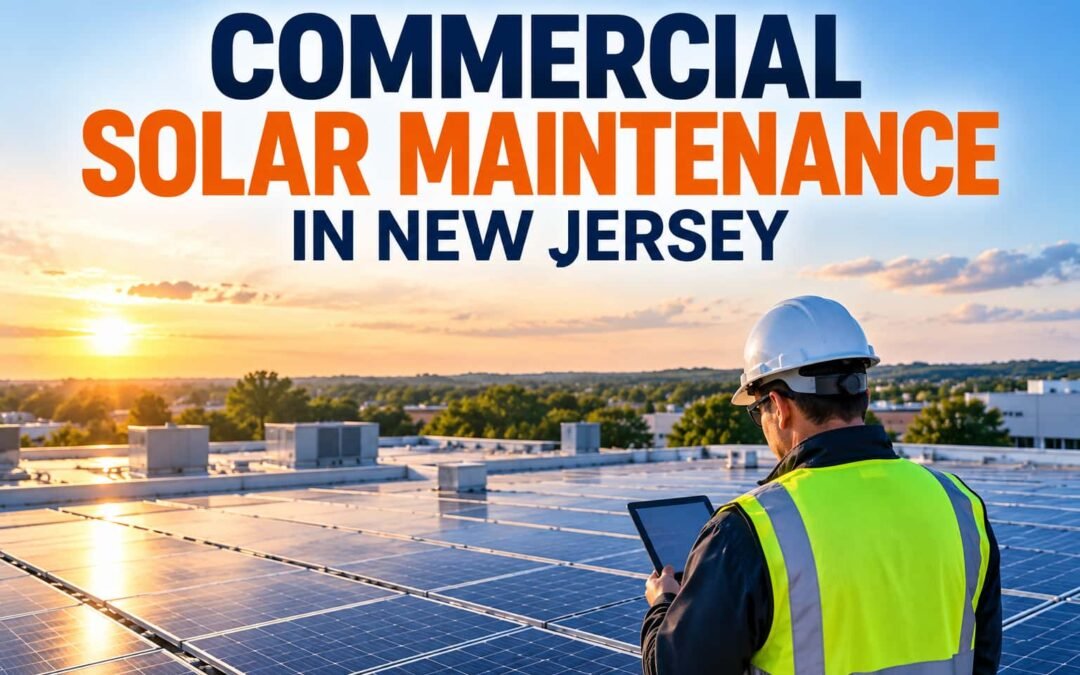
Commercial Solar Maintenance NJ
Installing solar panels on a commercial property is only the beginning of the investment. Once the system is operating, commercial solar maintenance, monitoring, inspections, and timely repairs become critical to protecting energy production and reducing unnecessary downtime. The U.S. Department of Energy provides information and resources on solar energy technologies and their role in commercial and other energy applications.
For businesses, warehouses, industrial facilities, office buildings, retail properties, and other commercial properties in New Jersey, a solar array should be managed as a long-term energy asset—not simply equipment sitting on a roof.
A commercial solar system that is producing electricity isn’t necessarily producing as much electricity as it should.
That’s where professional solar operations and maintenance (O&M) becomes important.
Why Commercial Solar Maintenance Matters
Commercial photovoltaic systems are generally larger and more complex than residential installations.
A commercial property may contain hundreds or even thousands of modules along with multiple inverters, electrical components, monitoring equipment, disconnects, communications equipment, mounting systems, and other infrastructure.
If one component develops a problem, the entire system doesn’t necessarily shut down.
Instead, part of the array may quietly underperform.
The business continues operating.
The solar panels continue producing.
But energy production may be lower than expected.
Without proper monitoring and maintenance, that performance loss can potentially continue for weeks or months before someone recognizes the problem.
For commercial property owners, the question shouldn’t simply be:
“Is my solar system working?”
A better question is:
“Is my solar system producing what it should be producing?”
Solar Panels Don’t Become Maintenance-Free After Installation
Solar technology has relatively few moving parts, but that doesn’t mean commercial solar systems should be ignored after installation.
Over years of operation, solar assets are exposed to:
- Heat
- Cold
- Rain
- Snow
- Wind
- UV exposure
- Dirt and debris
- Wildlife
- Roof activity
- Electrical wear
- Equipment aging
- Communication failures
Inverters, connectors, wiring, mounting equipment, monitoring systems, and other components can also develop problems independently of the solar modules themselves.
That’s why professional O&M should be viewed as part of the lifecycle of the system.
What Is Commercial Solar O&M?
Solar operations and maintenance (O&M) is the ongoing process of monitoring, inspecting, maintaining, troubleshooting, repairing, and documenting a photovoltaic system throughout its operating life.
For a commercial property, an O&M program may include:
- Preventive inspections
- Corrective maintenance
- Solar monitoring
- Production analysis
- Inverter diagnostics
- Electrical testing
- Thermal imaging
- IV curve tracing
- Drone solar assessments
- Troubleshooting
- Warranty management
- Equipment replacement
- Documentation
- Asset management
The exact program should depend on the size, design, age, equipment, operating history, and financial importance of the solar installation.
The Hidden Cost of Solar Downtime
One of the most important differences between residential and commercial solar maintenance is scale.
Consider a homeowner with one malfunctioning panel.
Now compare that with a commercial facility where a larger section of the array, an inverter, or multiple strings aren’t performing properly.
The financial impact can accumulate much faster.
This is why downtime should be treated as an operational issue.
A simple framework is:
Production Problem → Detection → Diagnosis → Repair → Verification
The longer the gap between the first and second steps, the longer the property may experience unnecessary production losses.
Professional monitoring can help reduce that gap.
Solar Monitoring: Your First Line of Defense
A commercial solar system should not depend solely on someone visually checking the panels.
Monitoring allows system operators to evaluate performance information and identify potential abnormalities.
Depending on the system and monitoring infrastructure, technicians may evaluate:
- Current energy production
- Historical production
- Inverter status
- Communication errors
- Performance trends
- System alerts
- Production anomalies
- Equipment availability
A monitoring alert doesn’t always provide the final diagnosis.
It tells us where to start investigating.
For example, an unexpected decrease in production could potentially be associated with equipment failure, electrical problems, shading, environmental conditions, communication issues, or other causes.
The monitoring system provides data.
Experienced technicians still need to interpret that information correctly.
Preventive vs. Corrective Solar Maintenance
Commercial property owners should understand the difference.
Preventive Maintenance
Preventive maintenance occurs before a major failure is known to exist.
It may include:
- Scheduled inspections
- Visual equipment checks
- Electrical inspections
- Monitoring reviews
- Thermal assessments
- Drone inspections
- Checking accessible connections
- Reviewing inverter status
- Identifying debris or animal activity
- Documenting equipment condition
The objective is to identify developing issues early.
Corrective Maintenance
Corrective maintenance begins when a known problem needs to be addressed.
Examples may include:
- Inverter failure
- Damaged modules
- Wiring problems
- Failed electrical components
- Communication failures
- Monitoring problems
- Damaged mounting components
- Storm-related damage
A strong commercial O&M strategy requires both.
Preventive maintenance helps find problems. Corrective maintenance solves them.
Drone Solar Assessments for Commercial Properties
Large commercial arrays create a practical challenge.
Inspecting hundreds or thousands of modules individually can require considerable time.
Drone technology provides another layer of inspection.
Visual and thermal aerial imaging can help technicians survey large arrays and identify areas that warrant closer investigation.
For example, thermal imaging may reveal unusual temperature patterns across modules or sections of an array.
Those anomalies can then be mapped and investigated more closely.
This creates a much more targeted process:
Survey → Identify → Locate → Test → Diagnose
rather than beginning a large inspection without knowing where the potential problem exists.
Thermal Imaging Doesn’t Replace Electrical Testing
This distinction is important.
A thermal anomaly is evidence that something deserves investigation.
It isn’t automatically a diagnosis.
A suspicious module identified through infrared imaging may require additional electrical testing or physical inspection to determine what’s actually happening.
For commercial asset managers, combining technologies can therefore provide much better information than relying on one diagnostic method alone.
That might include:
Monitoring + Drone Assessment + Thermal Imaging + Electrical Testing + Technician Inspection
Each tool answers a different question.
What Is IV Curve Tracing?
For more advanced commercial diagnostics, technicians may use IV curve tracing.
An IV curve represents the relationship between electrical current and voltage produced by a photovoltaic circuit under specific operating conditions.
Analyzing this information can help experienced solar professionals investigate performance abnormalities that may not be obvious from a basic visual inspection.
This is another example of why commercial solar maintenance goes far beyond washing panels.
Modern O&M is increasingly data-driven.
Commercial Solar Inspection Checklist
A professional inspection should consider the entire solar asset rather than focusing only on the panels.
| Area | What May Be Evaluated | Why It Matters |
|---|---|---|
| Solar Modules | Physical condition and abnormalities | Damaged or abnormal modules can affect performance |
| Inverters | Operating status and faults | Critical for converting solar power into usable AC electricity |
| Wiring & Connections | Visible condition and electrical integrity | Problems may create performance or reliability issues |
| Mounting System | Hardware and structural condition | Helps maintain array stability |
| Roof Interface | Areas around the solar installation | Important for rooftop system integrity |
| Monitoring | Communication and production data | Helps detect performance abnormalities |
| Thermal Performance | Unusual temperature patterns | Can identify areas requiring further investigation |
| Array Condition | Debris, shading and animal activity | Environmental conditions can affect operation |
| Documentation | Findings, repairs and system history | Creates a useful maintenance record |
The specific inspection should always be adapted to the system.
Commercial Solar Asset Management Goes Beyond Maintenance
For businesses with significant solar investments, maintenance is only one part of the picture.
Solar asset management takes a broader view.
Instead of asking only whether equipment needs repair, asset management looks at the long-term performance and operation of the solar investment.
That can involve:
- Production tracking
- Performance reporting
- Maintenance history
- Equipment condition
- Warranty management
- Service documentation
- Repair coordination
- Performance trends
- System upgrades
- Lifecycle planning
This becomes particularly important for organizations managing multiple commercial properties or solar installations.
Warranty Management Can Become Complicated
Commercial solar systems can contain equipment from multiple manufacturers.
Panels may have one warranty.
Inverters may have another.
Other equipment may have completely different coverage periods and requirements.
Then consider what happens when equipment fails several years after installation.
Who determines whether the component qualifies for warranty coverage?
Who communicates with the manufacturer?
Who coordinates replacement?
Who installs the replacement equipment?
Who verifies the system afterward?
These administrative issues can become surprisingly time-consuming for facility and property managers.
An experienced solar O&M provider can help manage the technical side of that process and keep appropriate service documentation.
What If the Original Solar Installer Is No Longer Available?
This is becoming increasingly relevant as the solar industry matures.
A commercial property may have a perfectly usable solar array even though the original installer:
- Closed
- Changed ownership
- Left the market
- No longer services the equipment
- Doesn’t provide commercial O&M
The solar investment doesn’t suddenly become worthless.
However, the property owner needs a qualified service provider capable of understanding an existing system and assuming ongoing maintenance responsibilities.
A third-party solar O&M provider can evaluate the installation, establish its current condition, review available monitoring information, identify outstanding problems, and develop a maintenance strategy going forward.
Roof Replacement and Commercial Solar Systems
Commercial roofing and solar eventually intersect.
If a roof requires major repairs or replacement, portions—or potentially all—of the solar array may need to be temporarily removed.
This isn’t simply a roofing project.
The solar equipment must be properly handled, stored, reinstalled, electrically reconnected, recommissioned, and verified afterward.
A commercial removal and reinstallation project can also provide an opportunity to evaluate:
- Existing modules
- Wiring
- Mounting hardware
- Equipment age
- Array configuration
- Damaged components
- Monitoring
- Potential system upgrades
The objective shouldn’t simply be to put everything back.
The objective should be to return the solar system to service correctly.
EV Charging and Commercial Solar
Commercial properties are also increasingly combining solar with electric vehicle charging.
For certain businesses, EV charging can support:
- Employee charging
- Company vehicle fleets
- Customer amenities
- Multifamily properties
- Retail locations
- Corporate sustainability initiatives
Solar and EV charging don’t automatically mean vehicles are powered directly from rooftop panels at every moment.
The electrical infrastructure, utility connection, solar production profile, charging demand, equipment, and building loads all need to be considered.
For businesses considering EV charging, the solar system should therefore be evaluated as part of the property’s broader energy infrastructure.
Battery Storage and Commercial Energy Resilience
Battery energy storage can add another layer to a commercial energy strategy.
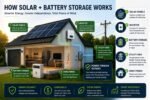
Depending on the system design and business objectives, storage may support strategies involving energy management, backup capabilities, or use of stored solar energy.
However, batteries shouldn’t simply be added because they’re popular.
A commercial property should first evaluate:
- Energy consumption
- Solar production
- Electrical infrastructure
- Load profile
- Operational requirements
- Backup objectives
- Utility rate structure
- Economics
- System compatibility
The correct energy solution should be based on data—not assumptions.
How Often Should Commercial Solar Panels Be Inspected?
There is no single maintenance schedule appropriate for every commercial solar system.
Inspection frequency can depend on:
- System size
- System age
- Equipment
- Roof type
- Location
- Environmental exposure
- Manufacturer requirements
- Performance history
- Monitoring capabilities
- Contract requirements
Some activities may be performed continuously through remote monitoring, while physical inspections occur periodically or when data indicates a problem.
The better approach is to develop a maintenance plan based on the actual asset rather than relying on an arbitrary universal schedule.
The Commercial Solar Maintenance Cycle
A useful way for property owners to think about O&M is:
1. Monitor
Track production and system status.
2. Detect
Identify abnormal performance, alerts, or physical concerns.
3. Inspect
Determine where the problem may be located.
4. Diagnose
Use appropriate electrical, thermal, visual, or analytical tools.
5. Correct
Repair or replace the affected equipment when appropriate.
6. Verify
Confirm that the repair resolved the problem.
7. Document
Maintain records for future maintenance, warranty, and asset-management decisions.
Then the cycle starts again.
That’s how solar becomes an actively managed asset rather than forgotten rooftop equipment.
Frequently Asked Questions About Commercial Solar Maintenance
Do commercial solar panels need regular maintenance?
Commercial solar installations benefit from ongoing monitoring and an appropriate preventive and corrective maintenance program. The specific requirements depend on the design, equipment, age, environment, and operating history of the system.
Can a commercial solar system still produce electricity if something is wrong?
Yes. Some failures or performance issues may affect only a portion of an array. That’s one reason monitoring and performance analysis are important.
Can Solar X service a system installed by another solar company?
Existing systems can be evaluated even when another company originally installed the equipment. This can be particularly important when the original installer no longer provides service.
What happens if a commercial solar inverter fails?
The impact depends on the system configuration. Technicians can diagnose the fault, determine the appropriate repair or replacement strategy, investigate applicable warranty options, and verify operation after service.
Are drone inspections useful for commercial solar?
They can be particularly useful for large arrays because aerial visual and thermal assessments can help identify specific areas requiring closer investigation.
Is solar panel cleaning always necessary?
Not necessarily. Cleaning decisions should consider the site’s environmental conditions, level of soiling, accessibility, safety, economics, and whether the expected production improvement justifies the service.
Can commercial solar panels be removed for a roof replacement?
Yes. Solar removal and reinstallation can be coordinated with commercial roofing work so the roof can be serviced and the solar equipment subsequently reinstalled and recommissioned.
Don’t Measure Your Commercial Solar Investment by Whether the Panels Are Still On
Commercial solar performance should be measured with data.
A system can look perfectly normal from a parking lot while a component is malfunctioning, an inverter is reporting faults, communications are down, or part of the array is producing below expectations.
The purpose of professional commercial solar O&M is therefore not simply to repair broken equipment.
It’s to create a systematic process for monitoring performance, identifying problems, reducing unnecessary downtime, protecting equipment, and managing the solar asset throughout its lifecycle.
For a business that invested substantial capital in solar energy, that’s an important distinction.
Commercial Solar O&M Services From Solar X LLC
Solar X LLC provides commercial solar operations, maintenance, monitoring, diagnostics, inspections, repairs, drone assessments, warranty support, removal and reinstallation, and asset-management solutions.
Whether you manage one commercial building or a larger portfolio of solar assets, the goal is the same:
Know how your system is performing, identify problems early, and protect the long-term value of your solar investment.
Contact Solar X LLC
Office:
1775 NJ-34 STE B4
Wall Township, NJ 07727
Phone: (732) 992-6323
Email: support@solarxpros.com
Website: solarxpros.com
Your commercial solar system is a business asset. Manage it like one.