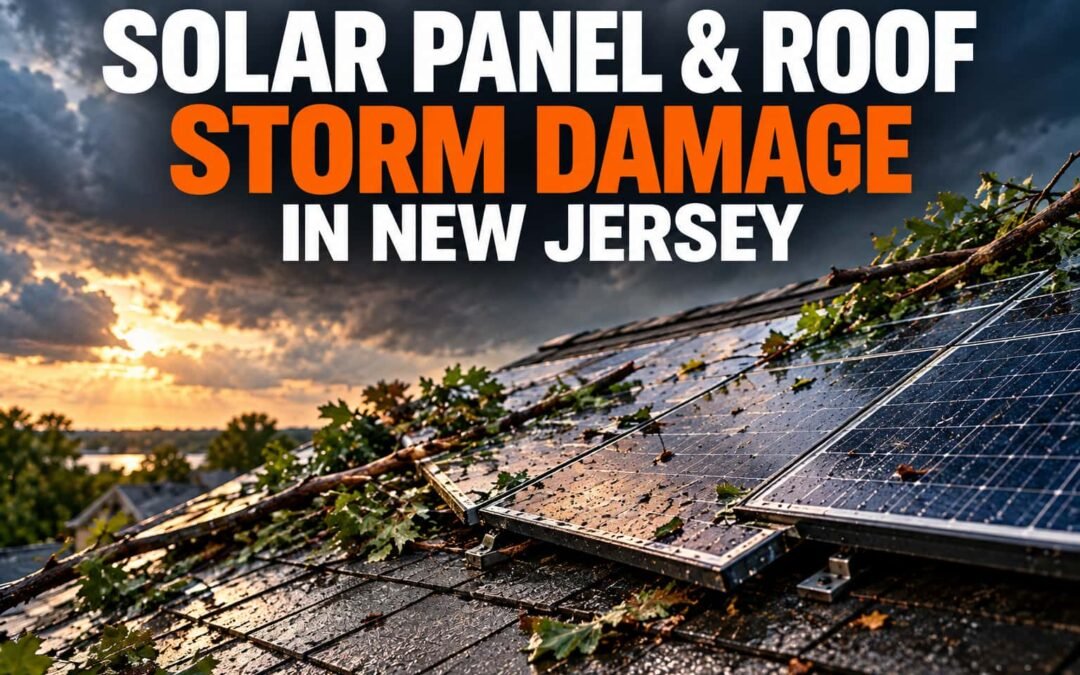
Roof Storm Damage
A major storm can affect more than your roof, trees, and utility power. Solar panels, mounting hardware, electrical conduit, inverters, batteries, monitoring equipment, and the roof beneath a solar array can all require attention following severe weather. The U.S. Department of Energy provides information about solar energy technologies and the components used in photovoltaic systems.
After a storm, don’t assume your solar system is operating normally simply because your home’s electricity has returned or the panels look fine from the ground.
Some solar problems aren’t immediately visible.
Roof leaks, communication failures, tripped breakers, ground faults, inverter alarms, damaged conduit, loose modules or attachments, and battery alerts can appear during or after severe weather—and some issues may become apparent only after utility service is restored.
If your New Jersey home or commercial property was affected by a major storm, Solar X LLC can help inspect the solar installation, diagnose potential storm-related problems, and determine what is needed to safely restore the system.
Recent New Jersey Storms Are a Reminder to Check Your Solar System
New Jersey properties regularly face high winds, heavy rain, coastal weather, falling branches, flooding, snow, ice, and other conditions that can affect rooftop equipment.
Following a significant storm, most homeowners naturally check their property for obvious problems:
- Missing roof shingles
- Fallen branches
- Water intrusion
- Gutter damage
- Downed trees
- Exterior damage
- Power outages
If your property has solar panels, however, the solar installation deserves attention too.
Solar photovoltaic systems are engineered for outdoor conditions, but severe weather can still expose existing vulnerabilities or damage components.
A panel doesn’t have to be shattered for a solar system to develop a problem.
That’s why a post-storm assessment should consider the entire solar system, not just whether the glass on the panels looks intact.
Your Power Is Back On—But Is Your Solar System?
This is one of the most important things to understand after a major storm.
When utility power is restored, homeowners often assume their solar system automatically returned to normal operation.
That isn’t something you should simply assume.
Following an outage and utility restoration, check your solar monitoring application or online portal if you can safely access it.
Look for:
- Normal solar production
- System status
- Inverter warnings
- Communication errors
- Battery alerts
- Unexpectedly low or zero production
- Equipment reported as offline
If your house has power but your solar monitoring system reports an error—or isn’t reporting at all—the solar installation may need professional evaluation.
Do not open electrical equipment, reset unfamiliar breakers, disconnect wiring, or attempt electrical repairs yourself.
8 Solar Problems to Watch for After a Major Storm
Storm damage doesn’t always mean broken solar panels scattered across a roof.
Here are some of the problems Solar X may investigate following severe weather.
1. Roof Leaks Around or Beneath the Solar Array
Heavy wind-driven rain can expose vulnerabilities in a roofing system.
If you notice water stains, dripping, damp drywall, ceiling discoloration, or other evidence of moisture following a storm, don’t ignore it.
The presence of solar panels can make the investigation more complicated because portions of the roof may be difficult to access beneath the array.
The source of a leak should be properly identified rather than automatically assuming the solar installation caused it.
The issue could involve roofing materials, flashing, storm damage, penetrations, or another condition.
If roof repairs are required beneath the solar array, some panels may need to be professionally removed and later reinstalled.
2. Solar Monitoring Communication Failure
Sometimes the first sign of a solar problem isn’t on the roof.
It’s on your phone.
Your solar monitoring app may suddenly show:
System Offline
No Communication
No Data
or another warning.
A communication problem doesn’t automatically mean the panels aren’t producing electricity. Monitoring and production are related but separate issues.
However, after a major storm or power outage, loss of monitoring communication deserves investigation—particularly if it persists after utility power has been restored.
3. Tripped Breakers
Electrical protection devices may trip in connection with abnormal system conditions.
If you discover that a breaker associated with your solar equipment has tripped following a storm, don’t repeatedly reset it without understanding why it tripped.
A breaker can be doing exactly what it was designed to do: responding to an electrical condition.
Repeatedly resetting electrical protection equipment without diagnosing the underlying issue isn’t an appropriate troubleshooting strategy.
Have the system evaluated by a qualified professional.
4. Ground Faults
Ground faults are electrical conditions that require proper diagnostic testing.
They aren’t something a homeowner should attempt to troubleshoot on a wet roof or by opening solar electrical equipment.
Storm conditions can introduce moisture, physical damage, wiring problems, or other factors that may contribute to electrical faults.
If your inverter or monitoring system reports a ground-fault condition, treat it seriously and arrange for professional inspection.
5. Inverter Alarms and Error Codes
The inverter is one of the most important components of a solar installation.
After severe weather or an outage, you may notice:
- Warning lights
- Error messages
- Fault codes
- Inverter offline status
- No production
- Reduced production
Take a photograph or screenshot of any error message if you can do so safely.
That information can be useful when contacting Solar X.
Don’t assume an alarm will resolve itself simply because utility power has returned.
6. Damaged Electrical Conduit
Solar installations may include exposed conduit and other electrical infrastructure running across the roof or building exterior.
High winds, falling tree limbs, flying debris, displaced equipment, or other storm conditions can potentially affect these components.
Never touch visibly damaged conduit, exposed wiring, connectors, or electrical equipment.
If something looks broken, displaced, crushed, disconnected, or otherwise abnormal, keep your distance and have it professionally inspected.
7. Loose Solar Panels, Modules, or Attachments
Strong winds can place significant mechanical forces on rooftop equipment.
From the ground, look for anything that appears obviously different from before the storm:
- A panel sitting at an unusual angle
- Misaligned modules
- Raised sections of the array
- Loose-looking equipment
- Debris lodged beneath panels
- Visible mounting problems
- Panels that appear shifted
Do not climb onto the roof to investigate.
A roof can be particularly dangerous after a storm because of wet surfaces, structural damage, loose materials, electrical hazards, and unstable equipment.
8. Battery Storage Alerts
If your solar installation includes battery storage, check the battery’s normal monitoring interface after utility service has been restored.
Watch for:
- Battery warnings
- Fault messages
- Communication problems
- Unexpected state-of-charge behavior
- Failure to return to its normal operating mode
Battery behavior during a grid outage depends on the system configuration.
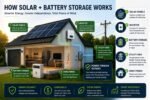
Not every solar installation can power a home during an outage. Solar-plus-storage systems designed for backup operation may isolate from the grid during an outage and reconnect after utility service is restored.
If the battery reports an abnormal condition after restoration, have the system evaluated rather than attempting internal repairs.
A Solar System Can Be Damaged and Still Produce Electricity
This surprises many property owners.
Solar damage isn’t necessarily all-or-nothing.
A system may continue producing electricity even when part of the installation has a problem.
For example:
- One section could be offline.
- An inverter could report an error.
- Monitoring could fail.
- A module could be damaged.
- Wiring could have been affected.
- Part of the array could be underperforming.
That’s why simply seeing production in your monitoring application doesn’t necessarily confirm that every component is operating correctly.
The better question is:
Is my solar system operating normally compared with how it performed before the storm?
What You Can Safely Check After a Storm
Homeowners can perform a basic assessment without climbing onto the roof or opening electrical equipment.
From the Ground
Look for:
- Visibly damaged panels
- Shifted or misaligned modules
- Fallen branches
- Debris on the array
- Damaged roof areas
- Missing shingles
- Exterior water damage
- Hanging or damaged equipment
Inside the Property
Look for:
- Ceiling stains
- Water intrusion
- New leaks
- Unusual electrical conditions
- Solar or battery alerts
From Your Solar Monitoring App
Check:
- Current production
- System status
- Inverter status
- Alerts
- Communication status
- Battery status, when applicable
If something doesn’t look right, document it with photographs or screenshots and contact a solar professional.
What NOT to Do After a Storm
This part is just as important.
Don’t climb onto a wet or damaged roof.
Don’t touch damaged solar wiring or conduit.
Don’t handle a loose or broken solar module.
Don’t repeatedly reset breakers or electrical protection equipment without knowing why they tripped.
Don’t open an inverter, battery, combiner, disconnect, or other electrical enclosure unless you’re qualified and authorized to work on that equipment.
Don’t assume the system is safe simply because the sun is shining or utility power has returned.
Solar panels can generate DC electricity when exposed to light, so damaged PV equipment requires appropriate electrical safety procedures.
What Does a Professional Post-Storm Solar Inspection Look For?
A professional assessment should look beyond the surface.
Depending on the system and suspected damage, Solar X may evaluate areas such as:
| Area | Potential Post-Storm Concern |
|---|---|
| Solar modules | Cracks, displacement, physical damage or abnormalities |
| Mounting & attachments | Loose, shifted or damaged components |
| Roof | Leaks, storm damage and areas beneath/around the array |
| Electrical conduit | Physical or weather-related damage |
| Wiring & connections | Visible damage or electrical faults |
| Inverter | Faults, alarms and operating status |
| Monitoring | Communication and production problems |
| Battery system | Alerts, operating status and communication |
| System production | Unexpected performance changes |
| Array condition | Debris, branches and other storm-related conditions |
The appropriate diagnostic process depends on what happened to the property and what symptoms the system is displaying.
Drone Solar Assessments Can Help After Severe Weather
Some storm damage is difficult to inspect from the ground.
That’s where drone technology can become useful.
For larger residential installations and especially commercial solar arrays, aerial imaging can help inspect areas that would otherwise require extensive rooftop access.
Depending on the situation, drone assessments may provide:
- High-resolution aerial imagery
- Documentation of visible damage
- Views of inaccessible roof areas
- Identification of displaced modules
- Documentation of debris
- Thermal imaging when appropriate
- Location information for areas requiring closer investigation
A drone assessment doesn’t replace electrical testing or technician expertise.
Instead, it helps Solar X identify where to investigate further.
What Happens If the Roof Is Damaged Under the Solar Panels?
This can be one of the most complicated consequences of storm damage.
Your roofer may determine that shingles, flashing, membrane, decking, or another part of the roof needs repair—but solar panels may be covering the affected area.
The roofer shouldn’t simply work around an active solar array.
Solar X can assist with solar panel removal and reinstallation when roof access is necessary.
A typical process may involve:
Step 1 — Evaluate the Solar System
Document the system condition and determine what equipment needs to be removed.
Step 2 — Safely Remove the Necessary Solar Equipment
Panels and related components are removed as required so the roofing contractor can access the damaged area.
Step 3 — Complete the Roof Repair
The roofing contractor addresses the storm-related roof damage or leak.
Step 4 — Reinstall the Solar Array
The solar equipment is returned to the roof after the roofing work is ready.
Step 5 — Recommission and Verify the System
The solar system should be properly returned to service and checked for normal operation and monitoring.
This coordination is especially important because repairing the roof shouldn’t create a new solar problem—and repairing the solar system shouldn’t leave an underlying roof problem unresolved.
Storm Damage Can Reveal Existing Solar Problems
Not every problem discovered after a storm was necessarily caused by that storm.
That’s another important distinction.
A post-storm inspection may uncover an older condition that hadn’t previously been noticed.
Examples might include:
- Existing wiring deterioration
- Previous roof issues
- Loose hardware
- Monitoring problems
- Animal damage
- Aging components
- Equipment faults
- Previously underperforming sections of the array
A professional assessment should distinguish, where possible, between obvious storm damage and pre-existing conditions rather than automatically attributing every problem to the weather.
Solar System Recovery After a Storm
The U.S. Department of Energy recommends a structured post-damage recovery process for photovoltaic systems, emphasizing that safety comes first and damaged systems should be inspected, tested and repaired appropriately before being returned to service.
The recovery process can be summarized as:
Make Safe → Inspect → Diagnose → Repair → Recommission → Verify
For a property owner, this means the goal isn’t simply to “turn the solar back on.”
The goal is to return the system to safe, normal operation.
Frequently Asked Questions About Solar Storm Damage
Can high winds damage solar panels?
Solar installations are designed to withstand environmental conditions according to their design and installation requirements, but severe winds and windborne debris can still damage modules, mounting equipment, electrical components, roofing, or other parts of an installation.
Should I turn my solar system back on after a storm?
If the system was shut down, damaged, flooded, displaying electrical faults, or you suspect physical damage, don’t attempt unfamiliar electrical procedures. Have the system evaluated by a qualified professional.
Why isn’t my solar system working after the power came back on?
There can be several causes, including inverter faults, communication problems, tripped electrical protection, system configuration, or other conditions. Professional diagnosis may be required if normal operation doesn’t return.
Why is my solar monitoring app offline after a power outage?
The issue could involve communications rather than solar production itself, but persistent monitoring failure after utility restoration should be investigated.
Can solar panels cause roof leaks after a storm?
A leak near a solar array shouldn’t automatically be blamed on the panels. The source could involve storm-damaged roofing, flashing, penetrations, or another roof condition. The actual source needs to be identified.
What if my roofer needs access underneath my solar panels?
Solar panels may need to be professionally removed to give the roofer access, then reinstalled and recommissioned after the roofing work is completed.
Can Solar X inspect a solar system installed by another company?
If your original installer is unavailable or no longer services your system, Solar X can evaluate existing solar installations and determine the appropriate next steps for troubleshooting, repair, maintenance, or restoration.
Should I inspect the solar panels myself?
You can visually inspect the property from a safe location and review your monitoring system. Avoid climbing onto the roof or touching damaged electrical or solar equipment.
Was Your Solar System or Roof Damaged by the Recent New Jersey Storm?
Don’t assume everything is fine simply because your utility power has been restored.
If you’ve noticed a roof leak, solar monitoring failure, inverter alarm, battery alert, tripped breaker, damaged conduit, loose solar panel, reduced production, or other unusual behavior following the storm, Solar X LLC can help.
Solar X can evaluate storm-related solar problems, inspect system performance, troubleshoot electrical and monitoring issues, assist with damaged solar equipment, and coordinate solar removal and reinstallation when roof repairs require access beneath the array.
Whether the problem is obvious or you’re simply unsure whether your system returned to normal after the storm, a professional assessment can help determine the appropriate next step.
Contact Solar X LLC for Storm Damage Assistance
Solar X LLC
Office:
1775 NJ-34 STE B4
Wall Township, NJ 07727
Phone: (732) 992-6323
Email: support@solarxpros.com
Website: solarxpros.com
Storm damage doesn’t always look dramatic. If something about your solar system, roof, inverter, monitoring, or battery doesn’t look right after severe weather, have it checked before a hidden problem becomes a larger one.